

Thursday, 1 January 2026
Melbourne Bike Grid Map
Summary: The Melbourne Bike Grid Map is Adrian Lobo's custom Google map of Off-Road and On-Road cycling routes and Points of Interest. Comparatively, Google Maps bicycling layer is a useful cycling infrastructure tool but it's hard to find complete or preferred routes and its directions are sub-optimal. I continually update the key routes, destinations and info of most relevance to Melbourne cyclists. This post will explain how to use the custom map and provide answers to common queries.


Friday, 3 October 2025
A simple guide on the essentials of bicycle wheels, rims and tyres
Summary: Understanding just the key things you need to know about your own bike's wheel, rim and tyre sizes, types and choices can be extremely frustrating for cyclists. Most people don't want to spend hours geeking over Sheldon Brown tables. They just want to understand what the weird notations mean on their own parts or online parts they are considering buying, work out what the most common (thus easy to replace or switch) sized parts are when buying a new bike or parts, and find out which options are best suited to their needs (e.g. for riding 5km to work in wet weather on a commuter bike).
This post will provide a simple guide to the essential things a utility cyclist needs to know about bicycle wheels, rims and tyres.

This post will provide a simple guide to the essential things a utility cyclist needs to know about bicycle wheels, rims and tyres.
Thursday, 2 October 2025
How accurate are Google Maps cycling time estimates?
Summary: Google Maps cycling directions are the primary route mapping tool used by cyclists. However, the recommended bike routes are generally sub-optimal and the cycling route time estimates can be quite inaccurate. Hence, for those who rely on bikes to get around efficiently, it's useful to know how to manually choose the best route and to understand how Google calculates its route time estimates. In this post I'll use my Melbourne Grid map and actual trips to explain how to use Google savvily to pick the quickest and most suitable routes.
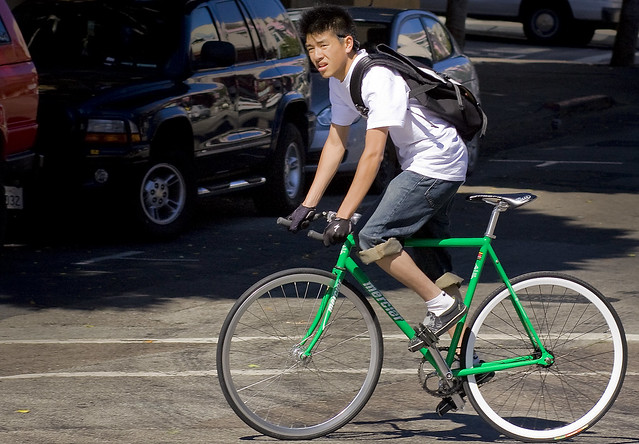
Flickr CC by 2.0 - Greg Balzer
Flickr CC by 2.0 - Greg Balzer
Wednesday, 1 October 2025
When is a Single Speed bike most suitable and how to make the most of one
Summary: A single speed bike can be the most suitable, flexible and low maintenance bicycle for many people to get around cities. This post lists the circumstances and cyclists that single speed bikes are most suited to. These include a lack of hills, wanting to minimise maintenance and ongoing costs, short to medium trip distances, and preferred speeds of 20-35km/hr.
For those who are suited to everything about single speed bikes except being limited to only 1 gear, there are two options:
(a) Get a flip-flop hub and put a larger sprocket on one side for the trips when the hills, wind or load requires an easier gear. (Typically flip-flop hubs have a fixed sprocket on the other side but you can fit a second freewheel there will just be a little less thread)
(b) Get a single speed bike with an internal gear hub. These can often be had on sale for ~$400 and usually offer either 3 gears (175% range) or 5 gears (~250% range) - which compares favourably to the ~400% gear range of a 20 speed road bike. I own a XDS Adult Street bike which is identical to a single speed except it comes with a 5 speed Sturmey Archer internal gear hub.
See: Are internal gear hub bikes the secret to low maintenance commuting?

cc licensed ( BY ) flickr photo shared by Mikael Leppä
For those who are suited to everything about single speed bikes except being limited to only 1 gear, there are two options:
(a) Get a flip-flop hub and put a larger sprocket on one side for the trips when the hills, wind or load requires an easier gear. (Typically flip-flop hubs have a fixed sprocket on the other side but you can fit a second freewheel there will just be a little less thread)
(b) Get a single speed bike with an internal gear hub. These can often be had on sale for ~$400 and usually offer either 3 gears (175% range) or 5 gears (~250% range) - which compares favourably to the ~400% gear range of a 20 speed road bike. I own a XDS Adult Street bike which is identical to a single speed except it comes with a 5 speed Sturmey Archer internal gear hub.
See: Are internal gear hub bikes the secret to low maintenance commuting?
cc licensed ( BY ) flickr photo shared by Mikael Leppä
How to prevent your bike being stolen
Summary: The risk of having your bike stolen can prevent you maximising the benefits of cycling for transport - both through losing access to it and because you may not use your bike for some trips due to the risk of theft. This post summarises the best advice on decisions, techniques and habits that will keep your bike safe while enabling you to use it as much as possible.

The best existing design solutions for transport utility bicycles
Summary: I have already covered the rationale for worthwhile and undesirable potential features of better utility bikes in: Designing a better utility bike in developing cycling cities. This post will collate the most outstanding, value-for-money design solutions already available in bikes or equipment that add significant usefulness to utility cycling for the majority of people. These include integrated chain locks, low maintenance drivetrains, flexible storage and integrated lights. Most of these examples are currently from Vanmoof as they are the standout designer of practical, robust solutions for utility cycling.
 Vanmoof bikes - Look book
Designing a better utility bike in developing cycling cities
Summary: Outside of the few northern European countries where utility cycling is mainstream, "Dutch bikes" are not the dominant utility bike of choice. In developing cycling cities in North America, the U.K and Australia, various types of bikes are used for transport that haven't been designed to optimise usefulness. Initiatives to design better urban/utility bikes and equipment in these countries are increasingly common. This post will provide comments and guidance on some of the key needs and challenges being addressed.
 Oregon Manifest Bike Design Project 2014 - Seattle "Denny"
Are internal gear hub bikes the secret to low maintenance commuting?
Summary: In Australia, derailleur bikes with 20-27 external gears are so ubiquitous that most people don't even know there is a type of bike with internal gears hidden in the rear wheel and only 2-11 gears. Yet, in countries like the Netherlands, where everyone bikes for transport, internal gears are standard and it's mostly sports cyclists who use derailleurs.
One could conclude that derailleurs still dominate in Australia because cycling is still mostly a sport or recreation. Utility bikes are breaking through but, presently, the ones with internal gears tend to be heavy, slow Dutch bikes or too expensive to take the leap of faith.
But if hills, winds or a disinterest in unnecessary exertion put you off a single speed for getting around, I've long considered internal gear hub (IGH) bikes with 3 to 8 speeds to be - at least in theory - the next best alternative. Especially, if you want to minimise bike maintenance and service costs, leave your bike exposed to the elements all year round, and don't use most of the gear combinations on a 20+ speed bike.
A recent clearance price ($399) on a commuter bike with a 5 speed Sturmey-Archer IGH has led me to finally having the opportunity to use a common IGH bike and in this post I will provide guidance on suitability, finding the best option, saving money, and will also update the long-term results (maintenance required, mileage I get out of the IGH). Because of the wider steps between IGH gears, my Sturmey Archer 5 speed (wide range model) is delivering ~80% of the effective range of my 20 speed road bike.

One could conclude that derailleurs still dominate in Australia because cycling is still mostly a sport or recreation. Utility bikes are breaking through but, presently, the ones with internal gears tend to be heavy, slow Dutch bikes or too expensive to take the leap of faith.
But if hills, winds or a disinterest in unnecessary exertion put you off a single speed for getting around, I've long considered internal gear hub (IGH) bikes with 3 to 8 speeds to be - at least in theory - the next best alternative. Especially, if you want to minimise bike maintenance and service costs, leave your bike exposed to the elements all year round, and don't use most of the gear combinations on a 20+ speed bike.
A recent clearance price ($399) on a commuter bike with a 5 speed Sturmey-Archer IGH has led me to finally having the opportunity to use a common IGH bike and in this post I will provide guidance on suitability, finding the best option, saving money, and will also update the long-term results (maintenance required, mileage I get out of the IGH). Because of the wider steps between IGH gears, my Sturmey Archer 5 speed (wide range model) is delivering ~80% of the effective range of my 20 speed road bike.

XDS Adult Street with 5 speed Sturmey-Archer internal gear hub
Tuesday, 30 September 2025
The complete guide to beater bikes
Summary: A beater bike (aka "pub bike") is a cheap, robust, undesirable bike you use when the risk of theft, vandalism and weather damage is highest - typically for shorter trips where you'll need to park your bike outdoors in a high risk area. Not everyone needs a beater bike, some people's primary bike is inexpensive, is locked securely and doesn't have much to damage. This post explains in what circumstances a dedicated beater bike is most useful, how to acquire and equip one, and how to get the most out of one.
 Flickr CC by 2.0 - Chris Metcalf
How cyclists can protect themselves from assault and robbery
Summary: Depending on the city you live in, where and when you ride and your vulnerability, you may be exposed to some risk of assault or robbery while cycling. The risk is often low but the impact on many people of an assault, robbery or other attack is massive. It can significantly reduce how much you use your bike and the stress-free enjoyment of riding when you do. Consequently, it is worth trying to minimise the risk of assault before it ever happens to you. This post provides advice on minimising the risks and measures you can take to better protect yourself.
CC by 2.0 - centralniak
CC by 2.0 - centralniak
Tips on using bikes with V/Line regional trains in Victoria
Summary: V/Line provides regional public transport in Victoria by train and bus. Taking bikes on trains to and from regional destinations is becoming more desirable for both commuters to Melbourne and for cyclists pursuing recreation in regional areas - especially given Victoria's fantastic rail trails.
Unfortunately, V/Line currently provides very limited and low priority services for those seeking to take bicycles on regional trains. Present regional train services accommodate only a handful of bikes at the best of times and the decision on whether to allow bikes at each station is solely up to the conductor. Official advice is to avoid taking bikes in the peak hour direction during weekdays from 7-9:30am and 4-7pm and any other busy times.
Nevertheless, there are various tips to maximise your chances of being able to take bikes on V/Line trains. I've collated them in this post. Experienced V/Line bike travellers have figured out how to make it work most of the time because there are few people committed enough to persist.

Unfortunately, V/Line currently provides very limited and low priority services for those seeking to take bicycles on regional trains. Present regional train services accommodate only a handful of bikes at the best of times and the decision on whether to allow bikes at each station is solely up to the conductor. Official advice is to avoid taking bikes in the peak hour direction during weekdays from 7-9:30am and 4-7pm and any other busy times.
Nevertheless, there are various tips to maximise your chances of being able to take bikes on V/Line trains. I've collated them in this post. Experienced V/Line bike travellers have figured out how to make it work most of the time because there are few people committed enough to persist.

Puncture-proof tyres are the key to reliable transport
Summary: The tyres most bikes come with have very poor puncture protection. Investing in puncture-proof tyres allows utility cyclists to avoid the incovenience of regular punctures. By eliminating punctures you can have completely reliable transport and this dependability will induce you to use a bike for many more trips around town.
I use and recommend Schwalbe Durano Plus (for 23-28mm width) or Marathon Plus (25-47mm width) tyres. Apart from choosing based on the width availability, Durano Plus is better for mostly on-road riding, longer distances, speed and comfort. Marathon Plus is heavier and slower but is the most puncture-proof, will take more wear, and has a bit better grip off-road than Durano Plus. However, for proper touring that includes various non-asphalt surfaces the Marathon Plus Tour is recommended.

cc licensed ( BY ) flickr photo shared by Phil and Pam Gradwell (to be)
I use and recommend Schwalbe Durano Plus (for 23-28mm width) or Marathon Plus (25-47mm width) tyres. Apart from choosing based on the width availability, Durano Plus is better for mostly on-road riding, longer distances, speed and comfort. Marathon Plus is heavier and slower but is the most puncture-proof, will take more wear, and has a bit better grip off-road than Durano Plus. However, for proper touring that includes various non-asphalt surfaces the Marathon Plus Tour is recommended.
cc licensed ( BY ) flickr photo shared by Phil and Pam Gradwell (to be)
Saturday, 22 July 2017
The best value commuter and utility bicycles available in Australia
Summary: The buying a bike and gear category on this blog contains several posts with guidance on choosing the most useful, reliable, low-maintenance and value-for-money bike and accessories to suit your circumstances.
However, I often just get asked to recommend some worthwhile bikes for commuting or getting around that are currently available in Australia, especially Melbourne - as that's where I live.
In this post, I will collate a list of the best value-for-money bikes available in Australia that I would consider for commuting or utility cycling. I include all of the bikes I own (Fuji Declaration single speed; Cell Otway 2.0 road bike, XDS Adult Street 5 speed internal gear hub bike), as well as ones I would consider buying if I had to replace one of my current bikes.
Some higher-end bikes become value-for-money when temporarily able to be had at steep discounts which is why I suggest starting with a search on Bikeexchange.come.au - Bikes - New - Between $190-$700. Higher-end bikes more purpose-built for utility cycling (e.g. Specialized Globe Work models) can occasionally be had for up to 50% less than their normal price, thus making them worthwhile.
As of July 2017, the best value-for-money bikes available most of the time are: Pedal Messenger ($199 on sale), SE Bikes Tripel ($350 on sale for a 3 speed), XDS Adult Street 5 speed (~$400 on sale), 2nd hand Cell Messenger or Fuji Declaration (~$180), Breezer Uptown (~$400 on sale), Polygon Path 1 ($399), Fuji Absolute (~$350), Progear FB-100 ($249), Progear RD-140 ($269), Polygon Strattos (~$580) or 2nd hand Cell Otway (~$300).

However, I often just get asked to recommend some worthwhile bikes for commuting or getting around that are currently available in Australia, especially Melbourne - as that's where I live.
In this post, I will collate a list of the best value-for-money bikes available in Australia that I would consider for commuting or utility cycling. I include all of the bikes I own (Fuji Declaration single speed; Cell Otway 2.0 road bike, XDS Adult Street 5 speed internal gear hub bike), as well as ones I would consider buying if I had to replace one of my current bikes.
Some higher-end bikes become value-for-money when temporarily able to be had at steep discounts which is why I suggest starting with a search on Bikeexchange.come.au - Bikes - New - Between $190-$700. Higher-end bikes more purpose-built for utility cycling (e.g. Specialized Globe Work models) can occasionally be had for up to 50% less than their normal price, thus making them worthwhile.
As of July 2017, the best value-for-money bikes available most of the time are: Pedal Messenger ($199 on sale), SE Bikes Tripel ($350 on sale for a 3 speed), XDS Adult Street 5 speed (~$400 on sale), 2nd hand Cell Messenger or Fuji Declaration (~$180), Breezer Uptown (~$400 on sale), Polygon Path 1 ($399), Fuji Absolute (~$350), Progear FB-100 ($249), Progear RD-140 ($269), Polygon Strattos (~$580) or 2nd hand Cell Otway (~$300).

Wednesday, 21 June 2017
How to get the most out of dockless bike share networks in Australia
Summary: Dock-based ("Kiosk") bike share has had very low usage rates so far in Australia, with Melbourne Bike Share having too few stations, too small a coverage area, and only minimum public funding to keep it in operation. There's been no exemption from mandatory helmet laws, though helmets are now often available with bikes. And, within the city centre, the retrograde introduction of free tram travel has become another obstacle.
Meanwhile, China has seen an explosion of privately-funded dockless bike share networks which have become extremely popular as the cheapest and quickest way to make short trips around cities.
Given the constraint of Australia's mandatory helmet laws, it's likely the only bike share networks that will be able to offer the low-cost coverage and convenience necessary to be even moderately successful, will be of the dockless variety. As of June 2017, the first of these private networks - oBike - has launched in Melbourne.
In this post, I'll collate feedback, tips and suggestions on how to make dockless bike share successful in cities like Melbourne - for users, companies and cities (e.g. as a complement to transit).
It's vital to be aware that Australian cities, and interested users within them, can't rely on the same drivers of success as China: Most Australians who would consider getting around by bike will buy one and have efficient access to it; Australia does not have a longstanding transport cycling culture, and its cities typically have less safe cycling conditions for occasional cyclists, including less safety in numbers. Those who want it to work in Australia long-term, will need to find and unlock the specific niches that are most useful here while not overinvesting. They'll also need to be creative about unlocking other revenue sources.
Note: This blog post is a work-in-progress which will be updated with further analysis and recommendations as I review the experience in Melbourne over time.

Meanwhile, China has seen an explosion of privately-funded dockless bike share networks which have become extremely popular as the cheapest and quickest way to make short trips around cities.
Given the constraint of Australia's mandatory helmet laws, it's likely the only bike share networks that will be able to offer the low-cost coverage and convenience necessary to be even moderately successful, will be of the dockless variety. As of June 2017, the first of these private networks - oBike - has launched in Melbourne.
In this post, I'll collate feedback, tips and suggestions on how to make dockless bike share successful in cities like Melbourne - for users, companies and cities (e.g. as a complement to transit).
It's vital to be aware that Australian cities, and interested users within them, can't rely on the same drivers of success as China: Most Australians who would consider getting around by bike will buy one and have efficient access to it; Australia does not have a longstanding transport cycling culture, and its cities typically have less safe cycling conditions for occasional cyclists, including less safety in numbers. Those who want it to work in Australia long-term, will need to find and unlock the specific niches that are most useful here while not overinvesting. They'll also need to be creative about unlocking other revenue sources.
Note: This blog post is a work-in-progress which will be updated with further analysis and recommendations as I review the experience in Melbourne over time.

Wednesday, 10 May 2017
The best value-for-money bike parts, equipment and consumables and where to buy them
Summary: If you asked a long-time utility cyclist for tips on which bike parts and equipment to buy you'd get plenty of hard-earned insights. Performance, reliability, durability, cost and ease of DIY maintenance or replacement vary considerably. Price or the most well-known brand names are often not useful guides. Bike shop salespeople are also biased to selling what they stock, has high margins or requires bike shop servicing.
In this post, I will collate my own current conclusions and decisions for reference. Note that as you gain more experience with more product types or alternatives you will continually refine your preferences, so this post will be updated indefinitely.
The best equipment is typically more expensive so actually being able to obtain it at the lowest price (including delivery) turns out to be a big factor in value-for-money decisions. For example, your local bike shop might sell Schwalbe Durano Plus tyres for $80 each which might force you to accept a lower puncture-resistant brand. But if you could get them for $40 online this changes the equation. Consequently, a key part of the aim of this post is to find the cheapest places to acquire each item.
 Flickr - Nicolai Bangsgaard
In this post, I will collate my own current conclusions and decisions for reference. Note that as you gain more experience with more product types or alternatives you will continually refine your preferences, so this post will be updated indefinitely.
The best equipment is typically more expensive so actually being able to obtain it at the lowest price (including delivery) turns out to be a big factor in value-for-money decisions. For example, your local bike shop might sell Schwalbe Durano Plus tyres for $80 each which might force you to accept a lower puncture-resistant brand. But if you could get them for $40 online this changes the equation. Consequently, a key part of the aim of this post is to find the cheapest places to acquire each item.

Sunday, 13 November 2016
Carrying kids on bikes - starting age, methods, safety and practicalities
Summary: If you and your partner have a bike-based lifestyle and then have a child, there's a lot to figure out regarding how to get around by bike until the kid is old enough to ride the trip themselves.
Our daughter Luka is now 10 months old and we are keen to start making bike trips with her. Until she is riding all types of trips herself (~5 years old), I'll be keeping this post updated with our decisions and answers to all of the common issues that arise including:
- What age is safe and practical to carry a child using a bike for common methods (centre versus rear kid seats, box bikes, rear trailers, etc)?
- What carrier methods are safest, most practical, and most affordable?
- Whether helmets are necessary for all ages and methods? And, if using a helmet, how to do so safely for infants? Are there alternatives to helmets for infants under 1 year?
- How to best deal with practicalities like the child needing to rest their head or nap?
- How to create genuinely safer routes including using off-road paths and footpaths in the safest way?
- How to ride with your partner and child so that the trip is as safe, stress-free and enjoyable as possible?
- The relevant laws and regulations that apply in Australia (starting age, helmets, footpath use, recommended minimum ages from manufacturers, etc)
Our Situation: Our daughter Luka has been in a Croozer Kid for 2 bike trailer and on a WeeRide centre-mounted bike seat since 10.5 months of age (she's much happier in the trailer). The WeeRide is too upright and the harness isn't great so I recommend a second-hand Yepp or Thule bike seat instead. She wears a Lazer Bob 46-52cm bike helmet in the bike seat but not in the trailer as she is happier with it off, the trailer is safer, and I ride very safely. (She'll start wearing a helmet in the trailer for some trips involving more on-road and high speed travel at around 2-3 years age). We use the bike seat only for very short trips when the trailer is too unsuited due to its size. The trailer is used for most trips (especially longer trips), when she'll need to nap in it or have weather protection, or when we need it as a stroller or for storage. At around 3 years, for the bike seat trips, she will switch to a rear seat as speeds will be higher and it's safer to brake with significant weight at the back rather than front.

Our daughter Luka is now 10 months old and we are keen to start making bike trips with her. Until she is riding all types of trips herself (~5 years old), I'll be keeping this post updated with our decisions and answers to all of the common issues that arise including:
- What age is safe and practical to carry a child using a bike for common methods (centre versus rear kid seats, box bikes, rear trailers, etc)?
- What carrier methods are safest, most practical, and most affordable?
- Whether helmets are necessary for all ages and methods? And, if using a helmet, how to do so safely for infants? Are there alternatives to helmets for infants under 1 year?
- How to best deal with practicalities like the child needing to rest their head or nap?
- How to create genuinely safer routes including using off-road paths and footpaths in the safest way?
- How to ride with your partner and child so that the trip is as safe, stress-free and enjoyable as possible?
- The relevant laws and regulations that apply in Australia (starting age, helmets, footpath use, recommended minimum ages from manufacturers, etc)
Our Situation: Our daughter Luka has been in a Croozer Kid for 2 bike trailer and on a WeeRide centre-mounted bike seat since 10.5 months of age (she's much happier in the trailer). The WeeRide is too upright and the harness isn't great so I recommend a second-hand Yepp or Thule bike seat instead. She wears a Lazer Bob 46-52cm bike helmet in the bike seat but not in the trailer as she is happier with it off, the trailer is safer, and I ride very safely. (She'll start wearing a helmet in the trailer for some trips involving more on-road and high speed travel at around 2-3 years age). We use the bike seat only for very short trips when the trailer is too unsuited due to its size. The trailer is used for most trips (especially longer trips), when she'll need to nap in it or have weather protection, or when we need it as a stroller or for storage. At around 3 years, for the bike seat trips, she will switch to a rear seat as speeds will be higher and it's safer to brake with significant weight at the back rather than front.

The Guardian
Monday, 26 October 2015
How can cycling best contribute to personal wellbeing and a better life?
Summary: Liveable city rankings are obviously flawed because quality of life varies considerably for residents based on where they live and their access to well-paid jobs and amenities. But the more damaging implications are that individual wellbeing is primarily at the mercy of politics, economics and planning, and that individuals should focus on maximising the suggested indicators (e.g. income, home ownership, private schools). A more useful exercise is to compile a list of the proven factors that significantly influence personal wellbeing, quality of life and happiness. And then to consider how you might optimise your housing, work, transport and lifestyle decisions to maximise the benefits. This post isolates many of these personal wellbeing factors and suggests how cycling can best contribute to leveraging them.
 The Australian Unity Wellbeing Index

Friday, 23 October 2015
The dirty secret of Yuppie urbanist's parking waivers: car ownership on the public teat
Summary: Among other things, New Urbanism principles favour policies that reduce the ownership and use of cars in order to improve liveability for all residents. In practice, Yuppie Urbanism uses the cover of progressive urban reform to primarily pursue the narrow interests of professional elites. Broad Shoup-style parking reforms are typically thrown in the too hard basket, and so obtaining waivers (special exemptions) from off-street parking minimums is a common element of new urbanism projects where commensurate car ownership and parking demand can be reduced. An egalitarian, scalable interest in policies that actually reduced private car ownership would seek unavoidable tradeoffs (no cheating) that were open to all developers and residents. The dirty secret of campaigns for parking waivers on specific projects is that some of these urban elites are cheating - escaping the cost of contributing to car parking supply while still owning private vehicles they park in free or highly-subsidised public space (e.g. on-street). In this post, I look at a specific example in Melbourne and discuss how it could be resolved fairly for genuine, scalable community benefit.

Nightingale proposed development in Brunswick
Tuesday, 30 June 2015
How to escape the tyranny of others' thoughtless car-centrism
Summary: I’ve already fully escaped from car-dependence and the accompanying costs, hassles, stress, health impacts and wasted time. I don’t use a car at all unless absolutely necessary for trips out of town, such as camping. If the trip is genuinely worthwhile, I’ll make the effort to organise a car through the best car share option I can find (currently Car Next Door). Unfortunately, sometimes family, friends or acquaintances arrange plans that presume we all own or use cars, and don’t mind hours of pointless driving or taking very expensive taxi rides. I've now quit accommodating these thoughtless demands. Rather than have to explain my justification in depth to each person, I wrote this post so I could just send it to those most aggrieved. Feel free to use it yourself; the case is watertight!
 Flickr CCby2.0 - Sakeeb Sabakka

Friday, 13 March 2015
What infrastructure and legal changes are needed to prevent dooring deaths in Melbourne?
Summary: In Feb 2015, Alberto Paulon was killed after being doored and pushed under the wheels of a truck driving alongside. This entirely preventable death occurred on Sydney Rd which has long been notorious for its high risk of dooring. This is exactly the same way James Cross died in another popular Melbourne street in 2010. However, a video of Alberto's incident has led to more media, political and community attention than normal, and there has been much debate on how to prevent future dooring deaths on this road and similar ones. Unfortunately, most of the mainstream discussion is ignorant of the key facts and real infrastructure and legal changes required to prevent these deaths. I'll use this post to concisely discuss them.

Friday, 16 January 2015
The Better By Bicycle Android app
Summary: If you have an Android phone you can now download the free Better By Bicycle app, which is intended to provide useful smartphone-targeted content for transport cyclists. It is only available for Android as the app maker I used (Andromo) is Android-only. This post will be updated with details of what I've currently incorporated into the mobile app and any ideas for new features. Please also use the comments to suggest any content for the app, such as links to the most outstanding articles, websites, videos, books, apps and Facebook Groups/Pages.

Sunday, 4 January 2015
The green illusions and false promises of the electric car (including Tesla)
Summary: Naive environmentalists have been fooled into thinking that private electric cars are green, sustainable and a necessary, key part of our transport future. In reality, electric cars are about sustainability only for the automotive industry and status quo financial and industrial systems. Thankfully, new sceptics like Ozzie Zehner, author of Green Illusions, have broken into the mainstream media with arguments dispelling the myths and greenwash around electric cars. I'll use this post to collate evidence that demonstrates why private electric cars will simply perpetuate our real problems (private cars, a commuting culture, a consumption and growth based economy). Bikes are the real solution for local trips, with public transport for longer journeys and car share and carpooling where required. And the focus of genuine environmentalists should be on transformative improvements to how we live, work, get around, and build a healthier, fairer society.

Friday, 2 January 2015
My calculated benefits of cycling for transport
Summary: In 2014, I cycled for 99% of my local trips in Melbourne between 2km and 20km (4000km). So this annual calculation exercise will demonstrate with hard facts whether cycling really can be cheaper, quicker, easier, safer, healthier and more enjoyable than the alternatives for getting around cities like Melbourne. For each criteria, I compare cycling with using a car or public transport.

cc licensed ( BY NC SA ) flickr photo shared by Greg Raisman
cc licensed ( BY NC SA ) flickr photo shared by Greg Raisman
Wednesday, 31 December 2014
The complete guide to electric bikes
Summary: Electric bikes (e-bikes, pedelecs) can make it feasible for more people in more types of circumstances to achieve many benefits of cycling for transport - specifically where distance, hills, winds, loads or fitness are barriers. However, it's important to consider: if e-bikes are really the best solution, if so, what type of e-bike to choose, and how to best use it to maximise cycling's advantages while not unnecessarily eliminating some benefits (e.g. free exercise, improving fitness/health) or introducing new barriers (risk of theft, ongoing costs). As I don't own or use e-bikes, this post will primarily collate links to the most helpful guides and resources.
 Superpedestrian Copenhagen Wheel
Tuesday, 23 December 2014
Why Mr Money Mustache's biggest secret of financial freedom is to ride a bike
Summary: Most people can benefit greatly from simple, candid and accurate guidance on how to really achieve financial freedom and put earning, spending and saving money into perspective with regard to what's really important in life. Mr Money Mustache (MMM) is one of the most popular personal finance bloggers in the world for doing just that. The connection with cycling and transport is simple - MMM advises that if he had to strip down his financial advice and philosophy to just one tip it would be to ride a bike. I agree and have a few insights that help clarify that it's not primarily about the money savings, it's about cycling's potential to transform your life for the better. This post will collate MMM's most salient posts and arguments about cycling vs driving in one place. This is especially important as many devotees of MMM or similar blogs struggle to fully understand how riding a bike can be so critical to a better life and financial freedom. Hence, they don't fully implement this element and I think they're really missing out. Also, if struggling to overcome the barriers to cycling, note that MMM doesn't write a transport cycling blog and his biking advice has some shortcomings that I've corrected in this post.
 Mr Money Mustache
Monday, 22 December 2014
Working less and more flexibly is desirable and a key to going car-free
Summary: Rethinking the purpose and desirability of conventional jobs is the key to eliminating car-dependent or miserable work commutes. Indeed, if you subtract the work commute, many more households could reduce or eliminate their car ownership. Logically then, there is a pathway for many households to follow, whereby reducing the number of work commutes and inflexible work constraints (e.g. being at work each day by a set time) enables alternatives to driving and car ownership to become feasible. This post will provide examples of how working less or more flexibly provides significant opportunities to reduce car ownership/use or make cycling and walking feasible options.
 Flickr CC by 2.0 - Robert Couse-Baker
Friday, 19 December 2014
Why you should campaign and vote to kill bad infrastructure projects
Summary: Big, expensive, city-changing infrastructure projects that are likely to fail, blowout in cost/time, cause major adverse impacts or simply miss the opportunity to radically improve the city, need to be killed as early as possible. You can't trust most politicians, bureaucrats, project-connected experts and especially private corporations to deliver the best social outcomes. Citizens need to inform themselves early enough to get directly involved in forcing the best decisions to be made. Urban cyclists often have the most to lose from bad projects as they shred funds that could be spent on cycling infrastructure as well as embed massive obstacles that entrench car-centric urban design. In this post, I'll collate salient articles and examples of these projects and the battles to kill or reshape them.
 Flickr CC by 2.0 - WSDOT
Wednesday, 17 December 2014
Opportunities, benefits and tips for mixed mode commuting
Summary: Mixed mode commuting simply involves combining more than one mode of transport in completing a trip - public transport, cycling, walking and driving. Many people that could gain some benefits from mixed mode commuting don't consider it carefully enough and stick to their existing mode (primarily driving or public transport only). Others struggle with the challenges of mixed mode commuting (connections, parking, flexible bike access). This post will collate opportunities, benefits and tips for getting the most out of mixed mode commuting with cycling as a key element.
 Flickr CC by 2.0 - EURIST e.V.
Tuesday, 2 December 2014
How to best improve cycling infrastructure through voting and political involvement
Summary: In modern democracies, the conventional way of achieving political change (laws, policy, public projects/initiatives) is through maximising the vote of the parties or candidates most sympathetic to your views. And also by influencing the policies and promises of these parties and candidates, and holding them accountable for commitments if elected. Most people are familiar with the many conventional ways of engaging in mainstream, conventional politics and so I won’t discuss them here. Instead, I’ll concentrate only on highlighting specific issues and opportunities in Melbourne that are not well known but may be worth

Wednesday, 26 November 2014
Why you shouldn't use Uber or companies like it
Summary: Many "sharing economy" boosters love Uber because it's been so successful so quickly, disrupted entrenched monopolies and is trailblazing the changes needed for similar peer-to-peer enterprises to take off. But even if offering valuable, new solutions, not all businesses are worthy of support. Uber is a classic example of a business where profit matters more than people and social consequences. In this post, I'll collate various articles that expose Uber's unethical philosophy and practices, and by extension all profit-seeking transport enterprises with similar priorities. However, real ridesharing and carpooling are important enablers of going car-free, so I will also try and identify the best alternate options available.

Monday, 24 November 2014
How to use a local sharing site to save money, learn skills and connect with neighbours
Summary: Websites that allow neighbours to freely and easily give away or lend goods, services and skills are a great asset for utility cyclists seeking to save money, learn or share skills and connect with their neighbours. In Australia, I recommend Streetbank as the best site to do this through. It enables genuine sharing, building neighbourly relationships (especially around common interests) and resilient communities. In this post, I'll provide cycling-related examples using Streetbank of how such sharing services can provide valuable advantages for individuals, neighbours and communities.
 Streetbank
Sunday, 23 November 2014
How to deal with windy conditions and still get around by bike
Summary: Windy conditions can be as big a deterrent to getting around by bike as heavy rain. However, experienced cyclists have ways to either avoid riding into the wind (at least the worst of it) or, when unavoidable, make cycling as efficient and safe as is feasible. This post explains some of the most common methods daily cyclists use to deal with the wind.
 Flickr CCby2.0 - Martin Mutch
Friday, 21 November 2014
How to use and contribute to Melbourne cycling safety data
Summary: Cycling crash and black spot maps and other safety visualisations capture a lot of attention but rarely provide individuals with accurate, self-explanatory means to determine the safest routes or best mitigate actual risks. This post will collate the various data, maps and apps for Melbourne and provide guidance on how individuals can best get value from this data and also contribute to improving cycling safety.
 CrowdSpot: Cycle Stories
Thursday, 13 November 2014
How to source cheap bike parts and accessories in Australia
Summary: Buying bicycle parts and accessories is unnecessarily expensive if you are forced to purchase them when not on sale and from a typical bike shop which has high costs to recover. I buy consumables (e.g. brake pads, chains) in bulk on special and wait for clearance prices on more expensive equipment. In this post, I'll provide details of some of the parts and accessories I've bought - prices, websites and tips on acquiring decent quality equipment cheaply.

Friday, 7 November 2014
How to deal with and report dangerous drivers
Summary: Urban cyclists are affected by or observe dangerous drivers much more frequently than they are involved in actual accidents. Unfortunately, much of this dangerous driving goes unreported and unactioned because there was no injury/damage or necessity for immediate police contact. This post explains what cyclists should do when confronted with dangerous driving or behaviour and how to best report it to police or other organisations and also follow up action. It will also document the outcomes of any reports I make myself.

Saturday, 1 November 2014
Guides to identify and choose the right bike parts and accessories
Summary: If trying to save money and become more self sufficient in maintaining and upgrading your bicycle parts and accessories you need to be able to accurately identify the parts that fit your bike/body and best suit your needs. Finding a comprehensive and simple source of useful reference information can be difficult. This post will collate various bike part and accessory buying guides and explanatory information.
 Flickr CCby2.0 - Dylan Moore
TransportCamp Melbourne data, apps, links and ideas
Summary: TransportCamp is an ‘unconference’ bringing together transport professionals, researchers, technologists and citizens interested in using open data, crowdsourcing, technology (apps, smartphones, etc) and innovative methods to improve urban mobility (citizen's efficient access to their desired destinations). I'm attending the Melbourne event and naturally have a focus on utility cycling. In this post, I'll provide useful links to resources and information of relevance. You can also find details below of my session - Mapping the Melbourne Bike Grid.
 Flickr CC by 2.0 - Derek Midgley
Monday, 27 October 2014
How to find secure bike parking at train stations and save on housing and commute costs
Summary: Most people will not walk more than a kilometre to access public transport so the premium on housing (buying or renting) for transit access drops rapidly after 1km. Yet with a bike, you can easily ride 1-4km quicker than most people's walking journeys to transit. Thus, bikes offer the potential to save considerably on housing costs by living in the 1-4km zone around transit stops. The critical enabler is having secure bike parking at these transit stops. While motorists are often massively subsidised with expensive park-and-ride facilities, cyclists who wish to park at train stations often have non-existent or insufficient parking facilities, so it's important to know where facilities do exist. This post provides guidance on Melbourne's existing secure bike parking ("Parkiteer" cages), current initiatives for building more of them, and how to pressure relevant agencies and officials to implement new or expanded Parkiteer cages where you need them.
 CC by 2.0 - Wikimedia Commons
Thursday, 23 October 2014
Transport tech fantasies vs existing cycling solutions
Summary: Self-driving cars, hyperloops, personal rapid transit and the myriad other high-technology solutions that are proffered as revolutionising future city transport are actually fantasies that will never be realised for mass, personal transport due to fundamental issues and constraints. However, the genuine interest in many of them is revealing of unmet needs or preferences, particularly from the perspective of people who wouldn't currently cycle for transport. This post identifies those unmet needs most relevant to cycling and advises of existing cycling solutions that enable individuals to obtain these benefits.
 Wall-E movie (Pixar)
Thursday, 9 October 2014
Why public transport hell persists and why only cycling can free you from it
Summary: While the quality of public transport can be improved, it never improves as quickly and comprehensively as it should because of some entrenched obstacles and challenges. Thus, despite the promises of politicians or hopes of advocates, public transport isn't going to get significantly better anytime soon. Nor is it something you can change yourself. Consequently, if limited to public transport, you could be stuck as a helpless victim of "public transport hell" forever. Driving a car in congested cities may offer some relief but is still expensive and inefficient, and often just as inconvenient, unreliable and unpleasant - just in different ways. This post will summarise the entrenched causes of public transport hell and explain why cycling is the only realistic escape.
 Tandberg, The Age
Subscribe to:
Comments (Atom)


